
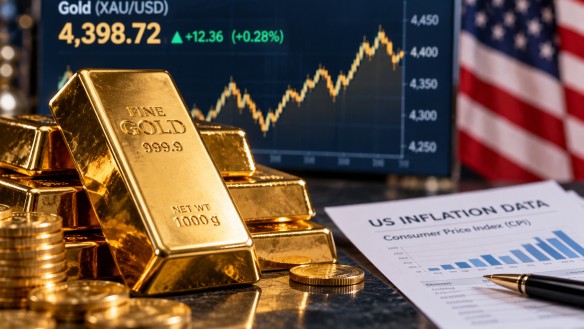
Gold prices are hovering near $4,400 an ounce as investors eagerly await new US inflation data that could shape expectations for the Federal Reserve’s upcoming interest-rate decisions. Spot gold has increased by roughly 0.4%, reaching approximately $4,418.87 an ounce, while gold futures have risen to around $4,461.82. This rise is partly attributed to a weaker US dollar, which has slipped to about 98.74 on the US Dollar Index, making dollar-denominated gold more appealing to buyers using other currencies.
However, the gains in gold are being tempered by rising US Treasury yields. The 10-year Treasury yield has climbed in response to plans to purchase up to $6 billion in longer-term government debt. Higher yields on government securities can deter interest in gold since these securities offer interest income, whereas gold does not. As a result, the opportunity cost of holding gold increases as bond yields rise.
Financial markets are also being influenced by rising oil prices, with Brent crude recently hitting approximately $100 a barrel. This surge in oil prices has sparked concerns about renewed inflationary pressures. Higher energy costs can lead to increased expenses for both businesses and consumers, making inflation more challenging to control. Consequently, investors are closely monitoring both oil and gold prices to gauge the global economic outlook.
The upcoming US inflation reports, beginning with the Producer Price Index followed by the Consumer Price Index, are anticipated to provide crucial insights into interest rate trajectories. A stronger-than-expected inflation reading could heighten expectations for tighter monetary policy, potentially exerting pressure on gold prices. Conversely, a softer inflation reading might bolster expectations for lower interest rates, potentially providing a boost to gold. Additionally, geopolitical tensions in the Middle East continue to drive demand for safe-haven assets like gold.
As gold trades near the $4,400 mark, its short-term direction is likely to depend on a delicate balance of factors. While a weaker dollar and safe-haven demand are bolstering prices, elevated Treasury yields and inflation concerns are imposing constraints. Investors are keenly focused on the forthcoming US inflation figures, which could signal the Federal Reserve’s next steps and determine whether gold maintains its upward trajectory or encounters renewed pressure in the coming sessions.