
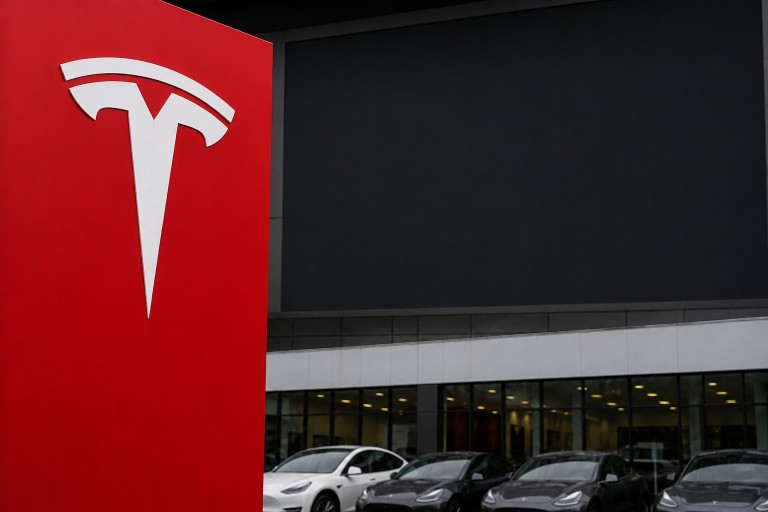
Tesla has reported second-quarter earnings that fell short of Wall Street expectations, with its profits not meeting analysts’ estimates despite higher-than-anticipated revenue. This financial performance led to a more than 3% drop in Tesla’s shares during after-hours trading. The electric vehicle giant recorded earnings of 31 cents per share, which were below the predicted 51 cents per share. However, the company’s revenue reached $28.23 billion, exceeding the forecasted $25.71 billion.
Throughout the year, Tesla’s stock has seen a decline of about 14%. This downturn comes as the company grapples with increasing competition from more affordable Chinese electric vehicle manufacturers and the consequences of the expiration of U.S. electric vehicle tax incentives. Despite the ongoing importance of vehicle sales, Tesla is progressively shifting its focus toward other ambitious projects, such as artificial intelligence, robotics, autonomous driving, and the development of its Robotaxi service.
CEO Elon Musk emphasized that the Optimus humanoid robot could eventually emerge as Tesla’s most significant product in the future. Nonetheless, he acknowledged that substantial technical and manufacturing challenges must be overcome before the robot can be produced on a large scale. Meanwhile, Tesla is actively expanding its Robotaxi service, with new operations set to launch in Tampa and Orlando, joining existing services in select parts of Austin, Dallas, Houston, and Miami.
In discussing the Robotaxi rollout, Musk highlighted the company’s cautious approach, ensuring that safety remains a top priority to prevent incidents that could lead to regulatory scrutiny. Currently, around 50 Robotaxis are operational in Austin, which was the first city to host the autonomous ride-hailing service. This careful expansion strategy reflects Tesla’s broader commitment to innovation while navigating the complexities of the emerging autonomous vehicle market.